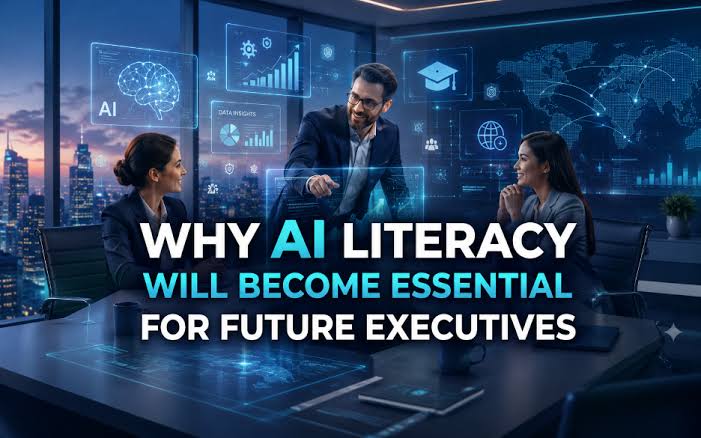
Artificial intelligence is becoming an increasingly important part of education, employment, communication, and everyday life. Students today are growing up in a world where AI-powered tools can answer questions, summarize information, generate ideas, analyze data, and support creative work. As these technologies become more common, understanding how to use them responsibly is becoming an important part of modern education.
AI literacy is not simply about knowing how to operate an AI tool. It involves understanding what artificial intelligence can do, recognizing its limitations, evaluating its results, and making responsible decisions when using it. For students, developing these skills can help them become more confident learners and better prepared for a changing professional environment.
What Is AI Literacy?
AI literacy refers to the knowledge and skills needed to understand and interact with artificial intelligence effectively. A student with basic AI literacy does not need to be an expert programmer. Instead, they should understand how AI systems are generally used and why their responses need to be evaluated.
For example, students should know that an AI system can generate an impressive-looking answer while still producing inaccurate information. They should also understand that different tools may have different capabilities, limitations, and privacy considerations.
This knowledge allows students to use technology as a learning resource rather than accepting every generated response without question.
Why Students Need AI Skills
Technology has always influenced education, but the rapid development of generative AI is creating a much bigger change. Students can now interact with tools that can explain concepts, generate practice questions, organize notes, assist with brainstorming, and provide feedback.
These capabilities can make studying more flexible. However, they also create a responsibility for students to understand when and how these tools should be used.
Developing AI literacy can help learners make better decisions about technology. Instead of asking an AI system to complete every task, students can use it to support their own understanding and improve their learning process.
AI Can Support Independent Learning
One important advantage of AI literacy is that it can encourage students to become more independent learners.
A student struggling with a particular topic can ask for another explanation, request an example, or practice answering questions. This can supplement traditional classroom instruction and give learners another way to approach difficult material.
However, independent learning still requires judgment. Students should compare AI-generated information with textbooks, academic sources, and guidance from teachers.
The goal is not to replace traditional learning resources. It is to give students another tool that can complement them.
Understanding AI Limitations
One of the most important parts of AI literacy is understanding that artificial intelligence is not always correct.
AI systems can produce inaccurate facts, outdated information, misleading explanations, or references that need verification. Because generated responses can sound confident and convincing, students may incorrectly assume that they are always reliable.
Learning to question AI-generated information is therefore essential.
Students can ask themselves several questions before accepting an answer:
- Is the information supported by a reliable source?
- Can the claim be verified elsewhere?
- Does the answer provide enough context?
- Could the information be outdated?
- Does the response contain assumptions or unsupported statements?
These habits encourage stronger research and critical-thinking skills.
AI Literacy and Critical Thinking
The relationship between AI literacy and critical thinking is particularly important.
Students who rely entirely on automated answers may have fewer opportunities to analyze problems independently. On the other hand, students who question, compare, and evaluate AI-generated information can use technology to strengthen their reasoning abilities.
For example, a student might ask an AI tool to explain two different viewpoints on a topic. Instead of copying the response, the student can investigate the evidence behind each position and develop an independent conclusion.
This turns AI from an answer generator into a tool for exploration and discussion.
Preparing Students for Future Careers
AI literacy is also becoming relevant beyond education. Many workplaces are introducing AI-assisted software for communication, data analysis, customer service, research, design, marketing, and other tasks.
Students entering the workforce may therefore be expected to understand how to work alongside intelligent technologies.
A student who understands AI concepts can adapt more easily when new tools appear. They may also be better prepared to identify opportunities where automation can improve efficiency while recognizing situations where human judgment remains necessary.
This makes AI literacy a useful part of career preparation.
Ethical Questions Matter
Using AI responsibly involves more than technical knowledge. Students also need to understand ethical considerations.
Academic honesty is one example. If a student uses AI to generate an entire assignment and presents it as their own work, they may violate institutional rules and miss an important learning opportunity.
Privacy is another concern. Students should think carefully before entering personal, confidential, or sensitive information into an AI system.
There are also broader questions about bias, fairness, copyright, and the responsible use of generated content. Education can provide students with the knowledge they need to think about these issues rather than simply adopting new technology without consideration.
Teachers Have an Important Role
Teachers can play a major role in developing AI literacy among students.
Instead of simply banning every AI tool, educators can explain appropriate and inappropriate uses. They can design assignments that encourage students to evaluate AI-generated information, compare it with reliable sources, and explain their own reasoning.
Teachers can also demonstrate how technology can support research and learning without replacing independent thought.
This approach helps students understand that responsible AI use is a skill that needs to be developed.
AI Literacy Across Different Subjects
AI literacy is not limited to computer science students.
Students studying business may encounter AI-powered analytics and automation. Those studying communication may work with content-generation tools. Researchers may use AI for organizing information, while educators may use technology to create personalized learning materials.
Even students in fields such as history, languages, science, and the arts can benefit from understanding how AI works and how it affects their disciplines.
For this reason, AI literacy can become a broader educational skill rather than a subject limited to technology programs.
Building a Balanced Approach to Technology
Students do not need to choose between traditional education and artificial intelligence. The most effective approach can combine both.
Books, teachers, academic research, classroom discussions, practical activities, and independent study remain valuable. AI can provide additional support when used thoughtfully.
A balanced approach encourages students to use technology where it adds value while continuing to develop skills that require human judgment.
The Future of AI Literacy in Education
As artificial intelligence continues to develop, AI literacy is likely to become an increasingly important part of education. New tools will appear, existing technologies will improve, and the ways people interact with digital systems will continue to change.
Education can help students prepare for this future by teaching them not only how to use technology but also how to question it.
Students who understand both the possibilities and limitations of AI will be better positioned to use it effectively. They can become more adaptable learners and develop the confidence needed to work in environments where technology is constantly evolving.
Conclusion
AI literacy is becoming an essential part of modern education because artificial intelligence is influencing how students learn, research, communicate, and prepare for their careers.
The most valuable AI skills are not simply knowing which buttons to press. Students need to understand how AI can support learning, recognize inaccurate information, protect their privacy, consider ethical issues, and maintain independent thinking.
When students learn to use artificial intelligence responsibly, technology can become a powerful addition to their education rather than a replacement for genuine learning. Building these skills today can help prepare learners for both the opportunities and challenges of an increasingly AI-driven future.